When you buy through links on our articles, Future and its syndication partners may earn a commission.

Astronomers have spotted the most distant and brightest "space laser," or megamaser, ever seen, and it's blasting out from a collision between galaxies that occurred when the universe was just half its current age.
This galaxy system, designated HATLAS J142935.3–002836, is emanating light that needed to travel for about 8 billion years before it reached the MeerKAT radio telescope in South Africa. The laser is specifically a hydroxyl megamaser, meaning it is similar to a laser but is seen in microwave or radio wave radiation rather than in visible light. The prefix "hydroxyl" refers to the fact that this space laser was created when hydroxyl molecules, each composed of one oxygen and one hydrogen atom, smashed into one another within the gas-dense, colliding galaxies.
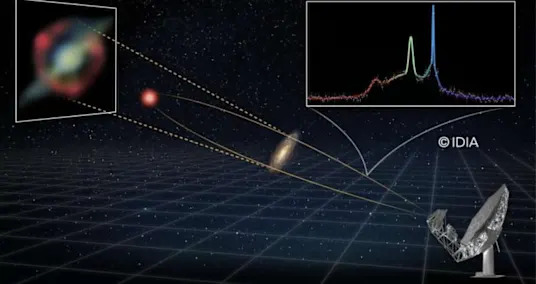
Even with its impressive brightness, HATLAS J142935.3–002836 wouldn't have been visible if it weren't for the influence of gravity on the fabric of space, aka the concept of gravitational lensing. This phenomenon was first predicted by Albert Einstein in his magnum opus theory of how gravity works, general relativity, back in 1915, and is still a key tool for astronomers exploring the universe.
Gravitational lensing describes what happens when light from a distant source, our megamaser in this case, passes by warps in spacetime caused by an object of great mass, like a cluster of galaxies. The closer that light passes to the warping object, or gravitational lens, the more strongly its otherwise straight path gets curved. As a result, light from the same object can arrive at our telescopes at different times, and this magnifies the background object.
"We discovered a very distant hydroxyl megamaser using the MeerKAT radio telescope. The signal comes from a galaxy at high redshift and is strongly magnified by gravitational lensing," discovery team leader Thato Manamela of the University of Pretoria told Space.com. "This magnification makes the emission easier to detect and allows us to study a system that would otherwise be too faint to observe."
Manamela added that megamasers are rare based on studies conducted in the near universe, usually found in bright infrared galaxies that contain huge amounts of gas and dust. These environments are often the result of two or more galaxies colliding and merging to birth a new "daughter" galaxy. Mergers like this trigger bouts of intense star formation, as well as creating the physical conditions that allow the hydroxyl molecules to amplify radio emission.
"This megamaser is unusual because it is located at a very large distance. That means we are observing it from a much earlier time in the universe," Manamela continued. "The signal is also gravitationally lensed, which boosts the brightness and provides a natural magnifying effect. This combination makes it one of the most distant and powerful hydroxyl megamasers known."
The fact that a megamaser is erupting from this galaxy collision indicates the presence of dense molecular gas and intense activity.
"By studying the emission lines, we can learn about the gas kinematics, the physical conditions in the galaxy, and the processes driving star formation," Manamela said. "Megamasers can also act as indicators of dual active galactic nuclei or pairs of supermassive black holes, systems that are expected to produce gravitational waves."
"This will help us understand how common megamasers were in the early universe and how they relate to galaxy evolution and star formation," Manamela concluded.
The team's research has been accepted for publication in the Monthly Notices of the Royal Astronomical Society Letters and is available as a preprint on the paper repository server arXiv.
latest_posts
- 1
 The most effective method to Apply Antiquated Ways of thinking in Current Brain science Practices
 - 2The best ice packs for coolers of 2026, tested and reviewed
- 3Birutė Galdikas: The last of the ‘angels’ in primatology’s most extraordinary chapter
- 4The Iconic, Instantly Recognizable Plastic Chair That's Known All Around The World
- 5Sound and Delightful: 12 Nutritious Smoothie Recipes





- What exactly is the Upside Down in 'Stranger Things'? The wormhole revelation, explained.
- The architect of Iran’s military survival remains defiant
- Let them eat (Taylor Swift) cake: The baker turning A-listers into life-size desserts
- Heavy rain, floods kill at least 45 people in Afghanistan, Pakistan
- A Manual for Pick Great Lawful Discussion Administrations For New businesses In 2024
- Turning into a Distributed Writer: My Composing Process
- Former United Launch Alliance CEO Tory Bruno joins competitor Blue Origin for national security projects
- ChatGPT served as "suicide coach" in man's death, lawsuit alleges
- Popular Film Areas: A Worldwide Manual for Film Enchantment